Electricity for sale at -15,000 EUR/MWh.
Read that again…
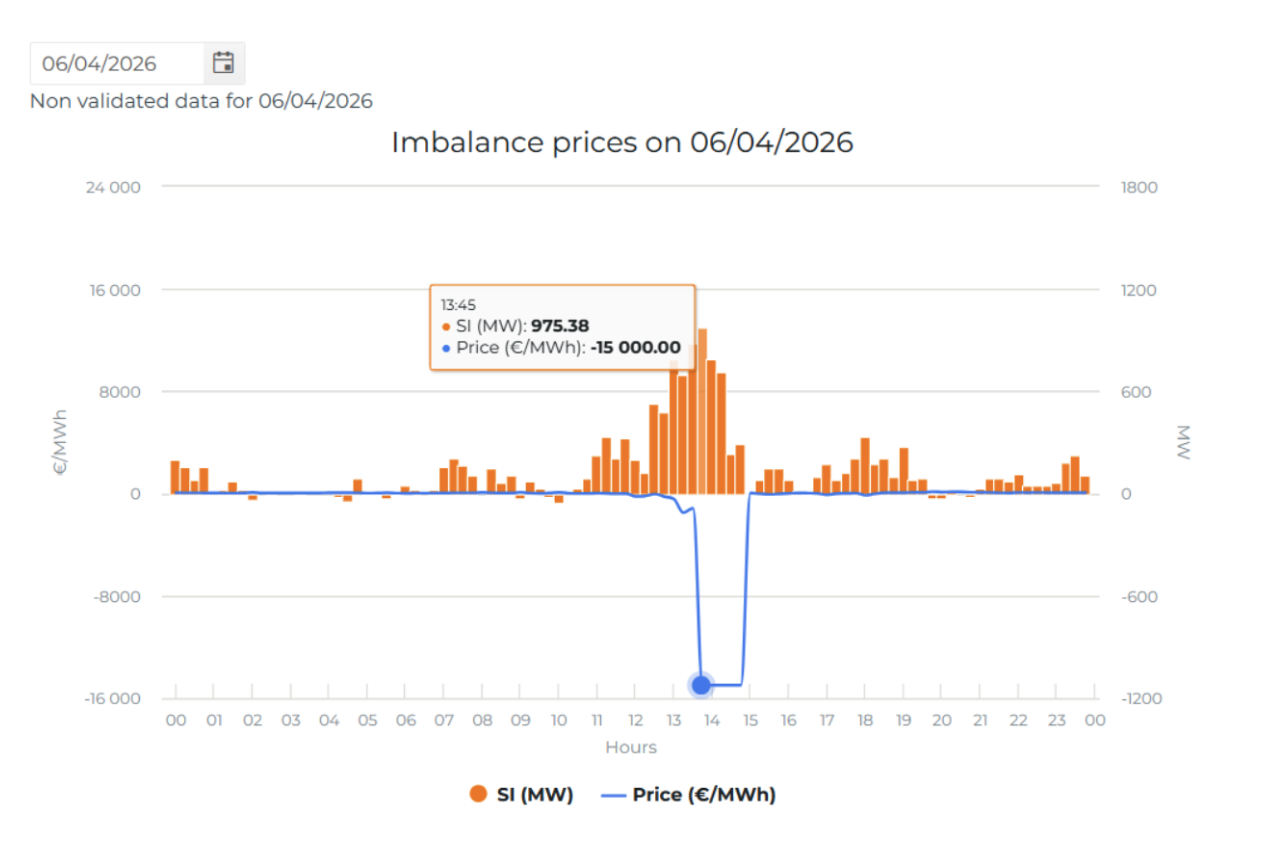
On Easter Monday, April 6, 2026, Belgian imbalance prices reached a historic low of -15,000 EUR per megawatt-hour for 5 consecutive quarter-hours. This is not only a record but also an absolute low, as even lower prices are (at least for now) structurally impossible.
To put that in perspective: anyone consuming 1 MWh of electricity at that moment was paid 15,000 EUR for doing so. And those producing at that moment without flexibility in the form of curtailment or a battery? They had to dig deep into their pockets…
The price of -15,000 EUR/MWh itself is currently marked as "Unvalidated" by Elia. Adjustments are still possible for a period of approximately two months. Earlier in 2024, such an adjustment was made after an extreme situation in early April, when the unvalidated price closed at -300 EUR/MWh only to be corrected to -4,200 EUR/MWh. It appears that any correction will still remain strongly negative for Easter Monday.
What exactly happened?
Easter Monday 2026 brought a perfect storm of circumstances:
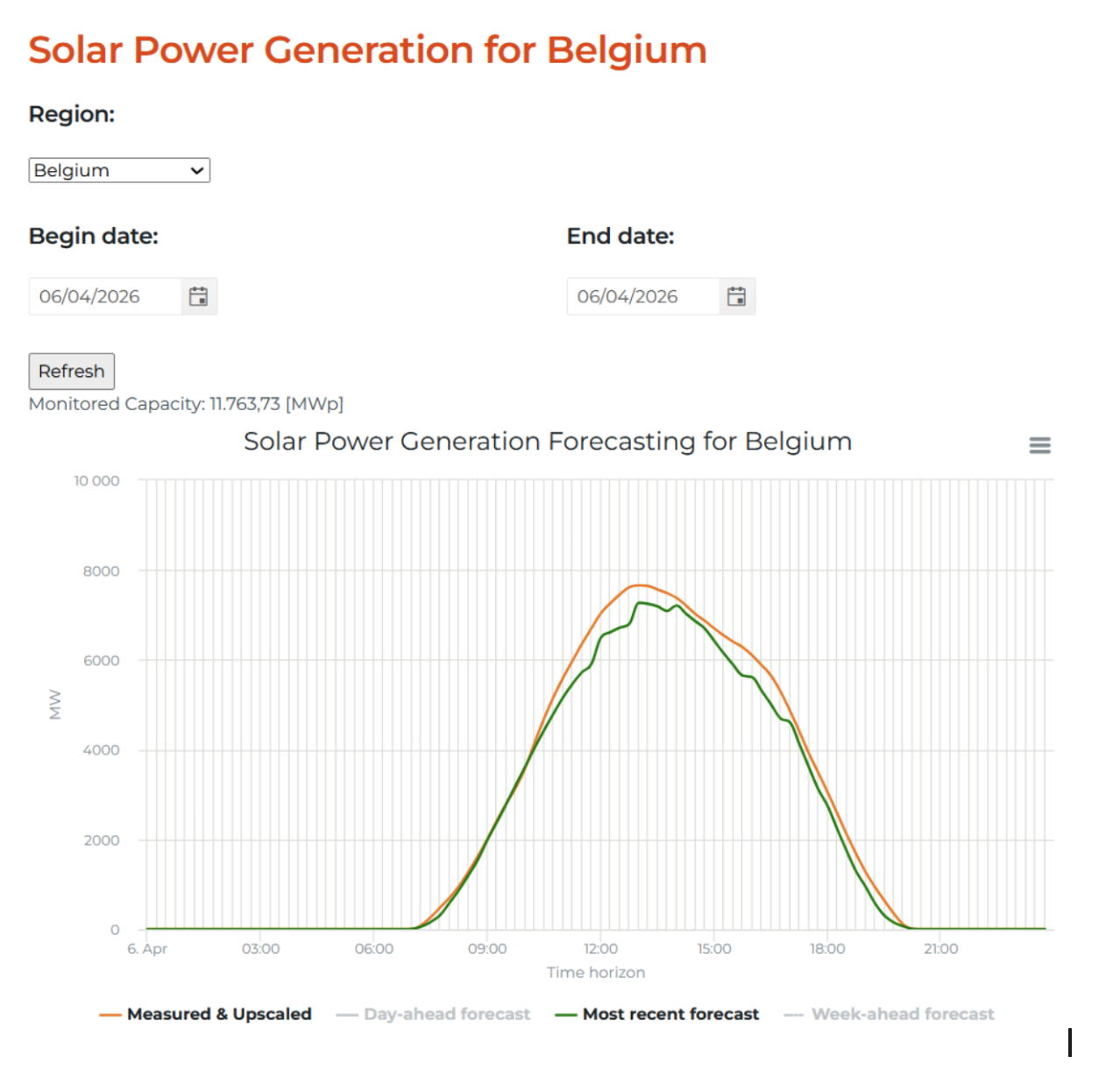
🌞 Solar panels at full capacity
Easter Monday brought beautiful spring weather. Hundreds of thousands of solar panels produced energy en masse, for approximately 1,000 MWp of installed capacity in 2025 — a first.
🏖️ Holiday = low demand
Easter Monday means closed factories, offices, and businesses. Electricity demand dropped to an absolute minimum, and forecasting consumption volumes becomes extremely difficult.
⚡️ No more aFRR - available
When the power grid became unbalanced by more than 1,000 MW due to these factors, there was no more downward automatic frequency reserve (aFRR-) available to absorb the surplus. The system essentially had no "brake" left. The result? Extremely negative prices applied to keep the grid in balance.
(More technical details? Check this analysis on LinkedIn by Jan Paul Harreman: https://www.linkedin.com/posts/jharreman_as-i-wrote-in-my-post-on-thursday-easter-activity-7446897152930418688-arBA/)
How YUSO customers profited?
Since day one, we've told our Embedded BESS customers: imbalance is your friend.
We realize that in the second half of 2025 and the first months of 2026, this may have seemed far-fetched: Price differences on the imbalance market had dropped significantly compared to previous years. Yet Easter Monday proved that this reasoning still holds — albeit in the longer term.
Where fixed contracts or day-ahead strategies fail during extreme price fluctuations, an imbalance strategy moves with the real-time market. And that pays off — especially during exceptional events like this that cannot be predicted far in advance.
What happened with our customers?
Batteries that consumed (charged) at the right moment were paid to take electricity, and YUSO controls more than 400 MW in Belgium alone
Smart control ensured batteries didn't discharge at the worst moment
Surplus production from solar panels (beyond self-consumption) was curtailed at multiple YUSO customer sites, generating profit through curtailment
The result: most YUSO customers ran profitable hours during one of the most extreme situations ever on the Belgian power grid.
"In the early morning on the energy exchanges (intraday continuous market), it quickly became clear that this would not be an ordinary day. This was confirmed with extra deep prices in the last auction of the day (intraday auction 3) around 10:20. The afternoon hours were already trading deeper and deeper below zero throughout the morning on the Intra-Day market, but nobody expected it to become such a deep price on the imbalance market. Deeper than -15,000 EUR/MWh is (still) not possible…"
Anthony De Kimpe, Portfolio Manager at YUSO
Without smart control, you pay double
Those who produced on Easter Monday without flexibility paid enormous costs.
A company with 100 kW surplus production from solar panels paid more than 10 EUR for grid injection at DA tariff alone. Curtailment based on imbalance prices at YUSO, on the other hand, yielded 1,200 EUR after costs. YUSO customers with both smart solar curtailment and a battery combine these benefits. The advantage of investing in flexibility will improve in the future as more solar energy goes onto the grid.
The bigger lesson
This type of extreme situation can repeat itself given the right combination of circumstances. Even if Elia adjusts the rules: the underlying dynamics remain — more renewable energy means more volatility, and more opportunities for those who can respond flexibly.
YUSO's Embedded BESS solution is built on this principle: real-time flexibility beats predictions. Our customers are not dependent on one strategy or one market. They are agile, intelligently controlled, and ready for both daily market conditions and exceptional moments.
Easter Monday 2026 was such a moment. And our customers were ready!
Are you ready for the next extreme price day?
Curious how your energy strategy holds up against extreme market conditions? Or how an Embedded BESS can make your business profitable — even during negative prices?
Contact our sales team or read more about our solutions at https://yuso.com